You know the competition is stiff if you’re trying to hire a customer reference management or customer marketing manager right now. There are the highest number of job postings we’ve seen over the past 18 years! As so many companies have—seemingly all at once—discovered the customer marketing imperative, we felt we needed to address the elephant in the room in the hope of preventing potential program failures. Here’s the question we’re often asked that gets to that elephant:
Does a customer reference program need a manager, and is that resource full-time, or can they have other responsibilities?
The short answers are yes, yes, and no. Here’s why.
There was a time when a customer reference program was, in reality, a case study factory. Find the happy customers, interview them, manage the approval process, upload the approved case studies to the website. Done. These success stories were captured opportunistically (i.e., beggars can’t be choosers) by different parts of the organization including PR, product marketing, and field marketing. Beneath these case studies were gushers of other advocate activity waiting to be tapped. But, extracting a drop was all anyone hoped for from those customer advocate wells.
Customer marketing has evolved way past that point. Here are some of the most significant differences:
Managing these relationships and related data, it’s not a static situation. Your advocate contacts change jobs and companies. Their sentiment about your solution or service changes periodically. When stakeholders look for a specific kind of advocate, the data they search for has to be reliable, or they will look elsewhere. What’s the issue with “elsewhere?”
It’s time-consuming, it’s frustrating, and the end result is more often “they’ll do” rather than “they’re perfect!”The right advocate is far more effective than “an” advocate, all other factors being equal.
Given where customer reference programs started (“Give this ‘project’ to the intern,” “Nick, who does other things involving customers, can take this on,” “We don’t need a senior person for this niche function”), it’s no wonder many managers/executives don’t put these programs on a par with demand gen, campaign management or events. They haven’t been around as long, and there are fewer examples of professional programs with real goals and results. Plus, there are relatively few program leader veterans with strong track records, and those veterans don’t come cheap.
So, here we are. A whole new generation of program managers is about to enter the domain. There is so much demand and so few candidates with depth in customer marketing that there will be steep learning curves and reinventing the wheel ahead. Hiring managers, please give these folks a fighting chance. Don’t expect them to run a reference program, write press releases, interview customers for videos and case studies, and run the booth at events (virtual or otherwise). Your reference program demands more: invest! This is a clear case of you get out what you put in. We have many good and bad case studies to back up this claim.
We’ve developed this graphic to illustrate all the components of a strategic customer reference management role, segmented by the frequency/cadence of the various tasks. Some of the tasks assume some system is in place (license assignments, system tuning), but most apply regardless.
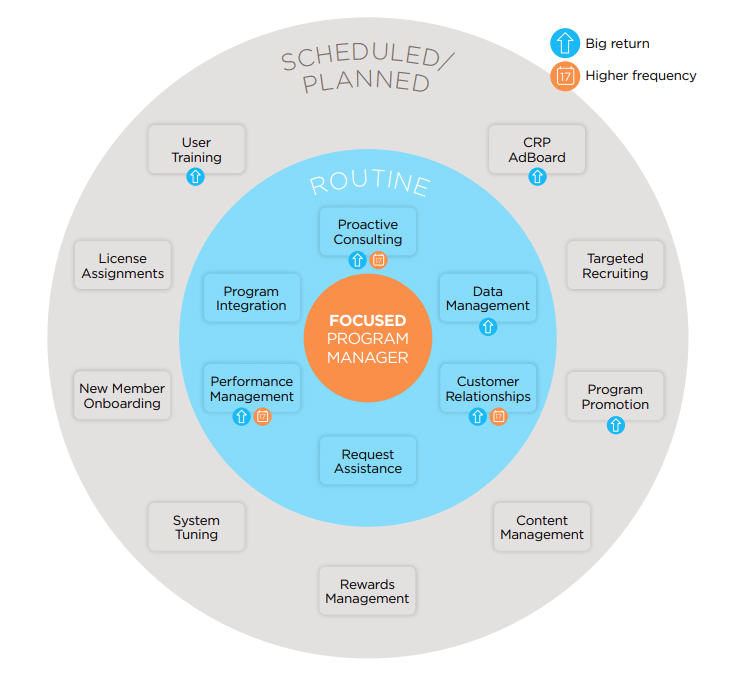
After reading through the enumerated tasks, try to imagine your new customer marketing manager, especially one with no or minimal experience, running a similar program, and doing all this effectively while juggling a few more jobs.
Something will have to give (i.e., be neglected). If a customer reference manager is also involved in events, the show must go on; no second chances! The events will get priority. When the customer marketing manager is also involved in PR, those releases must go off on a tight schedule nothing can interrupt. So, PR will win. Almost no other job meshes well with the time-sensitive, continuous relationship cultivation and maintenance nature of the customer reference manager role.
We believe that the most crucial aspect of being a reference program manager is ensuring stakeholders find what they need when they search for a reference. That involves synthesizing current demand and future demand into the optimally balanced database, knowing that “optimal” this quarter may be different than next, or a year from now.
This involves analyzing the current opportunity pipeline, having a firm grasp of company growth goals (and exactly how they will be achieved), and staying in sync with the needs of stakeholder groups (sales, digital, lead gen, AR, PR, etc.). This is the strategic part of the job and not even conceivable if the program manager is too mired in the tactical weeds or too unfocused.
Approach the customer reference management and the reference program like any other discipline. Hire the right leader, and the program will yield many, many dividends. Just consider a few of them:
In summary: You get out what you put in. So, give your program the best odds of realizing its potential—a full-time, focused program manager.
If you’d like to learn more on this topic, check out this blog, What a Strategic Customer Reference Program Manager Does.





.svg)
