When evaluating customer marketing, customer advocacy, or customer reference management technology, you have more choices than ever.
The better-known platforms include ReferenceEdge, Champion, Base, UserEvidence, Orca, Deeto, Peerbound, and SlapFive. They overlap in increasingly interesting ways, but they aren't interchangeable. They have different origins, architectures, strengths, and vastly different amounts of experience seeing firsthand how customer advocacy actually works in the real world.
Most providers make similar claims around advocate identification, engagement, community, content, customer references, sales enablement, automation, AI, integrations, and revenue impact.
The important differences are often buried beneath the feature label in how the feature actually works.
The best customer advocacy platform is the one that fits how your program actually operates, not the one with the longest feature list. Buyers should evaluate how each platform handles advocate identification, data maintenance, search and matching, requests and approvals, advocate overuse, activity tracking, measurement, CRM integration, user adoption, and AI.
Most importantly, don't ask whether a platform has a feature. Ask the vendor to explain exactly how it works.
Then be picky.
No vendor has complete knowledge of its competitors, including us.
We know ReferenceEdge extraordinarily well. What we know about competitors comes from prospects evaluating multiple platforms, former customers who migrate to ReferenceEdge, public materials, webinars, reviews, and occasional open demonstrations.
All moderately useful, but not even close to comprehensive.
The same is true when another vendor evaluates ReferenceEdge. So take vendor-authored comparisons, including this one, with an appropriately sized grain of salt.
Then compare what you see to what you know of how things work in reality. You're going to live with this decision for at least a year, and your reputation will, in part, rest on that judgment call.
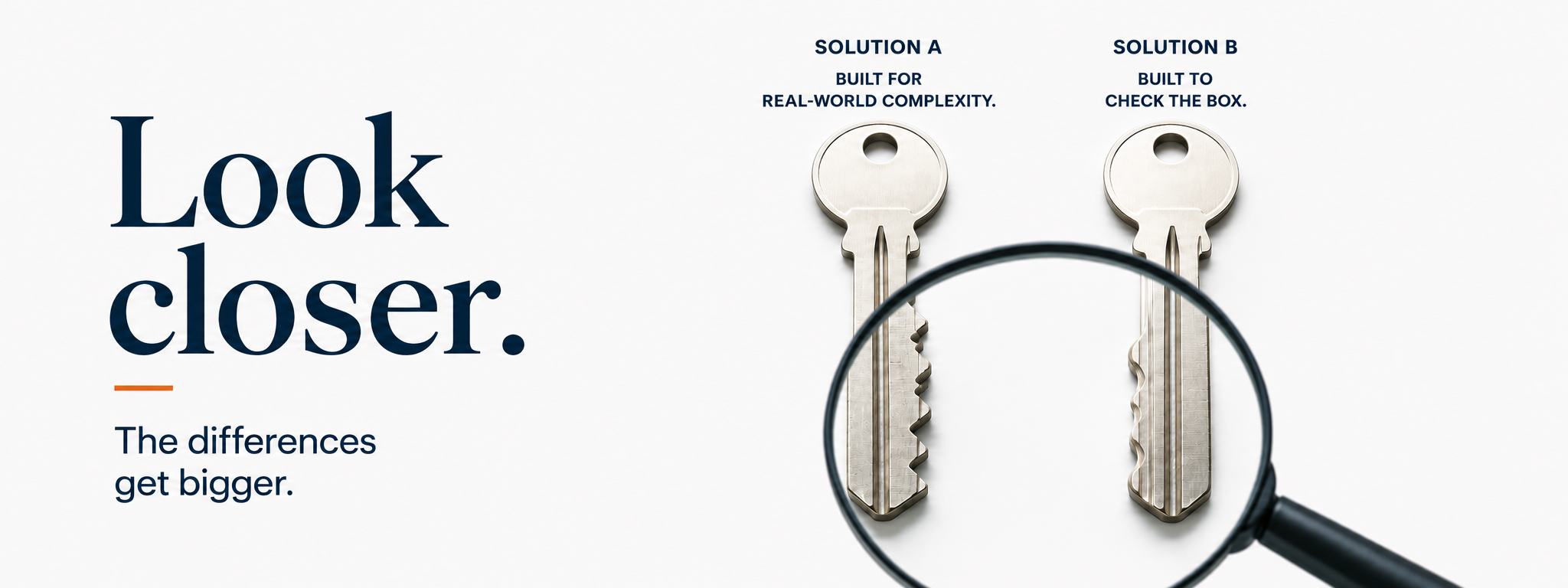
Feature checklists can be misleading because two customer advocacy platforms can claim the same capability while implementing it in radically different ways.
We've seen some fascinating, and head-scratching, examples.
One platform claims to have an advocate search feature, but users, even salespeople, have to run a report.
✅ Advocate Search, check!
But that's not the dynamic, iterative search users expect. If they want to change the search criteria, they literally change the filters, then rerun the report.
That's a cumbersome process that tests one's patience and doesn't encourage adoption.
Another vendor starts its nomination process in the application, then sends the nominator a Google form to complete outside the system.
✅ Advocate Nominations, check!
Every disconnected step gives a busy CSM or salesperson another opportunity to decide they'll do it later. "Later" is where an awful lot of advocacy participation goes to die.
And how does the nomination get back into the system?
We've seen a reference request process begin by asking the salesperson which contact they want to use.
✅ Advocate Search, check!
How would they know?
They're rarely looking for "Jane Smith." They're looking for someone who can credibly address specific buyer questions. A request process that assumes the requester already knows the right advocate has skipped one of the hardest parts of the problem.
One vendor claims an "automated" request process even though the advocacy program manager must facilitate every request.
✅ Automated Advocate Request, check!
ReferenceEdge supports that model. We call it a managed request. But as the only model, it doesn't scale. Period. Most program managers want to get out of the "concierge" business and remove themselves as a potential bottleneck.
That's why roughly 14 years ago we introduced peer-to-peer fulfillment, allowing the requester to work directly with the Sales or Customer Success manager who owns the relationship. No middleman, no delays.
One company showcases an "advocate fatigue score," visible during search.
✅ Advocate Overuse Prevention, check!
But if the system supports advocate use limits and tracks activity, why would an advocate ever reach fatigue? And how does a user interpret the score? Is 60 okay but 62 too high?
These aren't absurd product designs. That's precisely the point.
They sound reasonable if you haven't spent much time watching advocacy programs operate for a few decades.
We've supported hundreds of programs for more than 20 years.
A platform's origins matter because the problem it began solving determines the experience its developers acquire and influences how the product evolves.
Today's advocacy platforms didn't all begin by solving the same problem.
Point of Reference began in 2003 with a platform for customer interviews intended to supplant sales reference calls. Six years in, we learned that recorded due diligence interviews weren't replacing the live conversations most B2B buyers still expected.
So we pivoted and built ReferenceEdge around three fundamentals:
Other platforms came from different starting points.
UserEvidence traces its roots to TechValidate and survey-driven customer feedback. SlapFive developed around customer interviews and stories, similar to where Point of Reference began 15 years earlier. Base initially approached the market from customer marketing, engagement, and community, adding Sales support later.
Orca's founder was a Salesforce developer at a company using ReferenceEdge, where he built a homegrown replacement before eventually commercializing the product.
Champion, Deeto, and Peerbound are the newest entrants, arriving as programs were under intense pressure to demonstrate progress with AI. Not surprisingly, AI became central to their positioning from the outset, while deep advocacy domain expertise is still being accumulated.
Different starting points aren't inherently good or bad. But the problem you begin solving determines the experience you acquire and shapes the product you build.
There's also a striking pattern: nearly everyone eventually discovered that supporting Sales matters.
We knew that from the beginning.
Customer reference management isn't separate from customer advocacy; done robustly, it requires much of the same operational foundation used across an enterprise advocacy program.
ReferenceEdge is sometimes characterized as primarily a customer reference management platform, as though it's a distant cousin to customer advocacy.
That shows a misunderstanding of reference management.
A robust program requires:
Which of those becomes unnecessary to support Customer Marketing, PR, Events, Demand Gen, Product Marketing, Analyst Relations, or Social?
None.
PR may need a financial-services CIO for a media interview. Events may need a healthcare executive for a panel. Demand Gen needs webinar participants. Product Marketing needs beta customers.
The needs all leverage the same advocacy foundation.
So if someone tells you Point of Reference "only does reference management," ask: What exactly do you think robust reference management does?
Real-world customer advocacy experience matters because years of program variations, exceptions, mistakes, and lessons eventually become product decisions.
Longevity guarantees nothing. Old software can simply be old software.
What's valuable is accumulated learning. There's no shortcut, no matter how much venture capital is behind a product. We've worked with hundreds of programs with different structures, processes, governance, geographies, and philosophies. Those variations, exceptions, mistakes, and lessons eventually become product decisions.
That's experience becoming software. And it's difficult to absorb in a 45-minute demo.
A Salesforce-native customer advocacy platform operates directly on the Salesforce platform, while a Salesforce-integrated platform typically maintains a separate application and synchronizes CRM data between systems.
ReferenceEdge is built directly on Salesforce. Our first product wasn't, and we learned firsthand why that matters. When CRM and advocacy data live separately, data must be synchronized. There's another data store, another integration, and potentially another login.
ReferenceEdge operates within the customer's Salesforce environment and security infrastructure. CRM data doesn't need to be continuously replicated into another small vendor's cloud, and ReferenceEdge doesn't need to be integrated with Salesforce after deployment.
It's already there.
For non-native platforms, ask what Salesforce data gets copied, where it's stored, how frequently it synchronizes, what happens when synchronization fails, how quickly CRM changes become available, and what the integration costs.
Boring questions can be excellent buying questions.
Customer advocacy software succeeds only when people use it, and implementation and training alone don't create adoption.
Installing technology and training users is not change management.
Some organizations achieve extraordinary adoption with ReferenceEdge. Others deploy the same technology and barely get moving. The top difference isn't software. It's how the organization approaches change. If we could go back in time, we'd ask every new program manager:
"What do you see as your role in achieving user adoption?"
The answer would be remarkably predictive. With this perspective, we've developed extensive adoption resources, checklists, knowledge articles, a change-management playbook, and human support through assigned account directors. If a vendor's adoption strategy amounts to "we'll train your users," keep digging.
Buyers should understand what AI actually does, which model is being used, what data it accesses and retains, how permissions are enforced, and what token consumption could look like at scale.
AI deserves considerably more than a paragraph in a serious technology evaluation, so we've addressed it separately in our AI Buyer's Guide for Customer Advocacy Technology.
One particularly important question: is an advertised AI feature actually AI, or is it conventional automation?
That's not necessarily a criticism. Automation can be faster, more predictable, and dramatically less expensive in tokens for high-volume processes. But buyers should know what's actually happening. AI architecture, data governance, model choice, permissions, and token economics aren't side questions anymore. They're buying questions.
Before choosing customer advocacy technology, ask vendors to demonstrate how their platform handles the real work of running a program:
The biggest differences between customer advocacy platforms often emerge in the operational machinery underneath their features, not in the feature names themselves.
Every provider can deliver an impressive demonstration. The screens are pretty. The workflows glide. AI sparkles obligingly in the corner.
But you're buying what happens six months later when a salesperson urgently needs a very specific advocate, the obvious customer has already been used twice, another changed jobs, the account owner is traveling, and your program manager has 17 other things to do.
Or when PR needs an executive. Events needs a panelist. Demand Gen needs a webinar speaker.
The activity changes. The interface changes. The advocacy foundation doesn't.
So enjoy the demo. Then ask how the machinery works underneath it.
That's where the demo ends. And that's where the product begins.
A customer advocacy platform centralizes information about customer advocates and provides the tools to identify, match, engage, govern, track, and measure their participation in activities across Sales, Marketing, PR, Events, Demand Generation, Product Marketing, and other teams.
Look beyond the feature list. Evaluate advocate identification and data maintenance, search and matching, request and approval workflows, overuse protection, activity tracking, outcome measurement, CRM architecture, scalability, user adoption resources, and AI architecture.
Platforms buyers may encounter include ReferenceEdge, Champion, Base, UserEvidence, Orca, Deeto, Peerbound, and SlapFive. They differ significantly in origins, architecture, functionality, domain experience, and approach, so buyers should evaluate workflows rather than assuming similarly named features work similarly.
Yes. Robust customer reference management uses the same foundational capabilities required by broader customer advocacy programs: advocate data, identification, data maintenance, search and matching, governance, workflows, activity tracking, and outcome measurement. Sales is one beneficiary of that infrastructure, not its boundary.
If your company considers Salesforce its source of truth, yes. A Salesforce-native platform can eliminate CRM data synchronization and keep advocacy data within the Salesforce security and permission environment. An integrated platform may offer other advantages, but buyers should understand where data resides, how synchronization works, what it costs, and how security is managed.





.svg)
