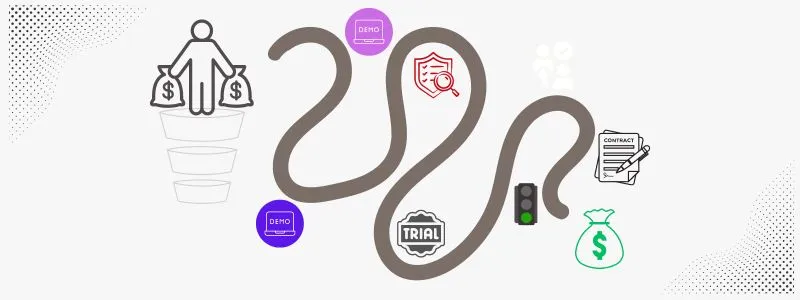
How well do you know your company’s sales process? How does a customer reference program manager know if customer advocate resources are being used by Sales to the fullest? This is a really important part of setting appropriate expectations (yours and leadership’s), as well as establishing continuous improvement goals aimed at winning more opportunities.
When we help a client estimate the activity volumes they should expect, we ask a lot of nuts and bolts questions regarding the Sales function. Pieced together, the answers provide necessary context, and paint a complete picture.
For some program managers this might be the first time they dive into the weeds of your company’s sales process, but it’s important to do so. Here’s an example of how it works. The blue entries are the particulars needed from Sales or Sales Ops leaders.
A) # quota-carrying salespeople500B) Average annual quota per salesperson$1,500,000C) Average opportunity size$180,000Average # opportunities per year8.33Average # opportunities per quarter2.08Average # opportunities per month.69
A) If your team is fairly homogenous the number of salespeople is a single number. However, there may be material differences (commercial vs. public sector, or enterprise vs. SMB) that warrant calculating these numbers separately for multiple segments.
B) Average annual quota is new or incremental revenue where references are most commonly employed (versus add-on licenses, for instance).
C) Opportunity size, coupled with volumes identified in the previous two questions, helps estimate the amount of revenue references contribute to the metric, revenue influenced, one of the most quantifiable measurements in our domain.
D) % of opportunities that require references to close70%E) Average # of reference accounts needed per opportunity2
D) How many opportunities require a reference seems like a simple question, but consider these sales process scenarios where references aren’t needed:
E) The number of references per deal varies. We hear everything from 1 to 5, or more. In industries like insurance, it’s not unusual for a B2B buyer to request a few current clients, a mixture of long and short-term clients, and even some former clients. This is in addition to the requirement of a particular organization size, geo, products, etc.
Below are the anticipated reference request needs each salesperson would have, if evenly distributed over the year. Multiple by the number of salespeople (A), and you have a good guesstimate of reference demand. The next step is to find out where the typical peaks and valleys are throughout the year, and weight accordingly.
Each SalespersonAverage # account requests per year12Average # account requests per quarter3Average # account requests per month1
Most customer marketers assume that salespeople are using customer advocates effectively. Don’t. If they are hunting for references through Slack or email blasts, it’s an unpleasant task and therefore avoid to whatever degree possible. Sometimes a buyer concern/objection arises and a salesperson doesn’t think, “We’ve got just the customer video or customer contact to jump on a reference call to remove the obstacle!” Optimizing customer reference use throughout the sales process take on-going work. This is where education comes in at new hire onboarding, and at virtual “lunch and learn” sessions offered throughout the year. What a great opportunity to share effective reference use success stories!
Ultimately, no goals are attainable unless customer references are being used as often as possible. They can’t help move a deal to close if they’re not inserted into the sales cycle at the right time. In our opinion the fundamental objective should be to increase the % of deals leveraging references to whatever level makes sense using the numbers in our exercise as a reality check. If you expect 70% of deals to leverage references and only 40% do, then additional discovery work is warranted. What’s in the way of achieving the ideal rate of 70%?
When achievement of this fundamental goal is reached, then revenue influenced, win-rates (with and without references), and sales cycle acceleration come with it. For more on program metrics, check out this post.
So you’ve set your goals based on anticipated activity and suddenly you’re missing your numbers. What happened? The Sales world is dynamic, ever changing. Your forecasts should be revisited quarterly in order to adjust expectations for seasonality, and other events that affect buying behavior.
You’ll find that understanding the inner workings of the Sales process at your company provides insights that drive the bulk of what you do as a program manager. Whatever Sales is tasked with in terms of company growth all other supporting functions (PR, Social, Digital, etc.) will have customer advocate needs all facing in the same direction. And that makes your priorities crystal clear.





.svg)
