Resourcesicon
Ensuring Quality and Impact of Nomination Campaign
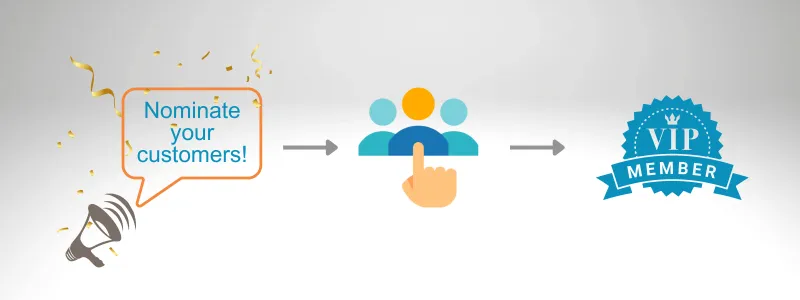
Megaphone saying Nominate your custmers with arrow to finger on people image with arrow to VIP member.

Ensuring Quality and Impact of Nomination Campaign

Customer advocate nomination campaigns are a proven, quick method for identifying customers who are highly satisfied and enthusiastic about your solution. They’re useful for building, rebuilding and filling gaps in your customer advocate database—the foundation of any program.

You can count on advocates changing jobs. You can expect Sales goals to shift to new areas of emphasis throughout the year. And you know you’ll need to combat emerging, competitive threats through credible advocate testimonials. A constant flow of new, energetic members is vital to consistently support your organization’s advocate demands.

Following is a planning guide packed with best practices to ensure your nomination campaign is precise and meets your objectives.

Identify Needs

The place to begin is with an assessment of current needs and/or gaps. This will help you size up the type of support and promotion that’ll be necessary. A campaign with a goal of 50 very specific candidates is quite different than a goal of 500 spanning 10 different segments.

The basic objective of a nomination campaign is to recruit customers who will advance company growth goals; current and near future. That means advocate success narratives that align with specific tactics such as increased focus on a particular industry, geography, partnerships, new products, and so on. A blanket request for nominations will result in a lot of irrelevant submissions, an avoidable waste of time and effort for everyone involved.

Set specific criteria for what makes a quality nomination. For example:

  • Personas/Titles
  • Products
  • Geographies
  • Industries
  • Tenure with your product
  • Use Cases
  • Activities (willing to do PR, provide sales references, speak at events, etc.)

Choose Audience

A nomination campaign could be run internally (customer success, account management, sales), or externally (customers). What’s right for your situation? Internal campaigns work well when your co-workers have solid relationships with customers, and there’s a culture of cooperation and participation, which requires strong leadership support. If there’s been a lot of turnover amongst the primary relationship owners, whether Sales or customer success, then you might choose to go directly to customers. Going this route can often have a political element as your effort might be seen as end running relationship owners. Resistance can be mollified by pointing out that less time and effort will be required of the relationship owners.

Utilize existing customer data to identify potential advocates to shortlist candidates. Consider NPS and traditional customer satisfaction survey results, engagement metrics, NPS scores, influence in their industry, and other relevant data points​​.

Motivation: incentives/rewards

This is most likely a part of the plan that will require leadership approval. Rewards come with a price tag. So, make a best guess estimate of rewards costs and volume of nominations and have that ready for leadership review.

You’ll reach your goal a lot faster if you incentivize the nominators. Roll the nomination campaign into an existing rewards program, or launch a new program for nominations. Talk to co-workers or customers and make sure the rewards you choose will motivate participation.

For salespeople, cash is king. Spiffs should be for qualified nominations to ensure quality. The amount has to be considered in the context of other incentives, and crafted to grab their attention. Is that $50, $100, $250? Is the number higher for the first X submissions? Is there a larger prize for the stakeholder(s) who nominated the most qualified submissions (e.g., $2,500)? Maybe there’s a drawing for one or more prizes to the top X nominators? There’s lots of room for creativity, just be sure to keep the rules easy-to-understand. We’ve got plenty of additional ideas in this blog post.

There are non-monetary benefits that motivate account owners. These include benefits for their customers (see below), better protection/less overuse of their customers, less time spent finding and making use of advocates, and more choice ensuring the best possible match for each need.

For customer-direct campaigns, becoming part of the advocacy program should have benefits that are clear and well-communicated. These benefits tend to be less transactional, designed to create stronger bonds with the company such as increased visibility, peer networking, access to executives, exclusive event access, roadmap input, early access to new features, and other perks​​. Again, more ideas may be found here.

Leadership’s Role

Like most cross-functional, as well as customer-facing initiatives, having leadership support is often a pivotal factor. Senior leadership must provide visible support and secure the cooperation of line managers (especially Sales and Customer Success), where the rubber meets the road. Do not underestimate how important this group of managers are to participation from your end-users. Nomination campaign announcements have to come from these managers, and ideally include what is to be gained (or lost) from high (or low) participation.

Logistics

You don’t want any SNAFUs after the campaign is launched. Have your processes in place, tested and ready to execute before the first nominations start coming in. Time is of the essence. Set SLAs for each step. You may have unique aspects to your campaign, but here is a list of activities that apply to any campaign.

  • How to collect
    Ideally, nominations are collected through a web form in order to standardize data collection, and streamline the process for the nominator. Whatever your collection method, reviewing and acting on each submission in a timely fashion is essential.
  • How to qualify and onboard
    Every program manager will have a different preference when it comes to this step. Will there be a 1:1 call with each prospective advocate—whether nominated by a CSM or the customer herself? Will that call be purely a welcome, or used as an opportunity to ensure every advocacy opportunity is explored? Alternatively, perhaps a simple email confirmation and thank you is deemed sufficient?
  • Follow up
    Regardless of the submission follow up approach, what will the SLA be: 2-4 hours from submission, 24 hours, 48 hours? Letting nominations sit on a shelf is frustrating to those who nominated, or self-nominated. Side note: Once a customer is activated as an advocate in the program, get them into use. If a customer agrees to be an advocate, don’t let them sit idle for long.
  • Reward issuance
    What will the turnaround be for issuing the reward? Is there an order that must be placed? If so, by whom? You want to minimize the lag between the activity and reward.

Communication Plan

You can have the best campaign ever, but a lack of awareness will spell its doom.

Clear communications concerning the campaign will determine the results. Create a multi-channel plan using any and all channels available to get the word out (Teams/Slack, email, social media, in-product prompts, etc.). There may be several rounds of communications with goals of creating buzz, educating, and, of course, conveying the “what’s in it for me?” for the nominator. Address each of the following as part of your plan:

  • The goal
    This might be something like: Our goal is to add 150 new customer advocates in the following segments who will participate as event speakers, sales references, and interview subjects for press, videos and case studies. That’s the big picture.
  • The criteria
    You want quality versus quantity. Be specific. For example: We are looking for director level technical managers that have been customers for at least 3 years, in the technology, healthcare and financial services industries, have an HR use case, with North American HQs, and use product A, B or C. These are the particulars.
  • The timeframe
    We believe shorter is better. If the campaign runs for 2 months vs. 2 weeks, you will see activity in week one, a trickle, then a modest spike in week 8. A narrow timeframe maintains focus and energy, and you get what you need more quickly so you can move forward. Dragging out this process in the interest of not overburdening the nominators does not yield a better campaign result. It only delays the availability of qualified advocates for marketing and sales initiatives.
  • The process
    Nomination directions should be simple and clear. Complexity will reduce participation. Be sure anyone can understand where to go, what’s needed, and what happens after submission. Test those directions on a subset of your audience, don’t assume.
  • Potential benefits
    Be sure the rules of the game are clear, easy to understand. Again, test the description of rewards on a subset of your audience, don’t assume. Use engaging content like videos, infographics, and blog posts to explain the advocacy program and reasons to participate.

In Flight Engagement

Once live, campaign performance should be monitored closely. Soliciting feedback from participants will identify any “hitches” in the process. Maybe the issue is unclear instruction, or you’re getting nominations that are off-base, or there’s a technical glitch with the web nomination form. These issues must be addressed quickly, with a sense of urgency.

For internal campaigns it’s useful to leverage the competitive nature of salespeople if they’re part of the campaign. A leaderboard accomplishes this need nicely.

Track the performance of your nomination campaign. Measure the number of nominations, the quality of nominees, and the overall impact on your advocacy program​​. Managers should receive periodic status reports on how their teams are doing in terms of the campaign goals. The nomination initiative is a topic on daily/weekly/monthly team meetings/calls for a month or more (often the program manager attends).

The Wrap

A well-executed nomination campaign is pivotal for building a robust customer advocate database. By setting clear objectives, defining specific criteria, and choosing the right audience, you ensure that your efforts are targeted and productive. Leadership support and a comprehensive communication plan are essential to drive participation and achieve your goals. Remember to incentivize nominators appropriately and maintain a seamless process from nomination to reward issuance. Regularly monitor campaign performance and address any issues promptly to keep momentum high. By following these best practices, you can create a dynamic and effective advocacy program that not only fills current gaps but also supports future growth and combats competitive threats with credible testimonials. Begin implementing these strategies in your nomination campaigns and knock your recruiting goals out of the park! Our team can help support these advocacy efforts through our supplemental staffing services, learn more today.

As this infographic illustrates, a mature advocacy program is responsible for continuously identifying advocates, maintaining accurate advocacy data, protecting customer relationships, and aligning with top company goals to accelerate growth.

The infographic contains six key components. Here's a description of each for you to translate into your own talking points.

-

1. The Customer Journey: From Customer to Discoverable Advocate

Every advocate starts as a customer.

The journey begins when account teams, customer success managers, support teams, and services organizations create positive experiences that build trust and confidence.

As customers achieve success, some become enthusiastic supporters of the company, its products, and its people. These customers are identified as potential advocates and introduced to the advocacy team.

The advocacy team interviews these individuals, learns about their experiences, captures important details about their interests and expertise, and creates a searchable advocate profile.

The result is a discoverable advocate: someone who can be found, matched, and engaged when the business needs credible customer voices.

Without this process, valuable customer relationships remain hidden inside co-workers’ heads or team spreadsheets, unavailable to the broader organization.

2. Many Teams. One Goal.

Great advocates are rarely discovered by the advocacy team alone. It’s really just too much to ask of any one part of the organization. Every customer touchpoint plays a part in cultivating and retaining advocates.

Customer success managers see customer enthusiasm firsthand. Account teams hear success stories during business reviews. Support teams witness customer loyalty. Product teams interact with passionate users who influence future direction.

A successful advocacy program creates a systematic way for all customer-facing teams to identify and nominate potential advocates, as well as a means for customers to self-identify..

Think of it as building a talent pipeline.

The broader the participation across the organization, the stronger and more diverse the advocate community becomes.

This collective effort ensures the advocacy database reflects the full spectrum of customer success stories across industries, products, geographies, and use cases.

3. The Advocacy Team: Stewards of the Bedrock Data

The advocacy team serves as the steward of the organization's advocacy data.

Their responsibilities fall into three primary areas.

First, they recruit continuously. Advocates change jobs, priorities shift, and customer enthusiasm naturally evolves over time. Maintaining a healthy advocacy community requires constant replenishment.

Second, they keep information current. Customer stories, product deployments, business outcomes, and willingness to participate all change. Outdated advocacy data quickly becomes unreliable.

Third, they measure and report value. Advocacy programs must demonstrate their contribution to business outcomes such as customer acquisition, retention, and expansion.

Beyond maintaining records, the advocacy team actively shapes the composition of the database to align with company growth objectives. This is essential if the program is to be seen by executives as a strategic lever vs. a low-level function an intern can run. 

If the company’s strategic direction includes expanding into healthcare, launching a new product, selling through a new channel, entering Asia, or targeting a specific buyer persona, the advocacy team ensures the advocate population evolves accordingly.

In many ways, they function as portfolio managers for one of the company's most valuable assets: customer credibility.

4. Advocates Power the Enterprise

Most organizations initially think of advocacy as a sales resource.

Sales certainly benefits from customer references, but advocacy creates value far beyond the sales organization.

  • Demand generation teams use advocates to improve campaign performance.
  • Public relations teams rely on customer voices to strengthen media stories.
  • Product marketing teams use customer experiences to validate positioning and messaging.
  • Investor relations teams use customer success stories to reinforce market confidence.
  • Digital teams create customer-driven content that resonates more strongly than vendor-created content.
  • Executives benefit from authentic customer perspectives during strategic discussions, presentations, and industry events.

The common thread is credibility.

Advocates provide something no marketing budget can purchase directly: authentic proof from real customers.

5. Integrated Program Components

Most mature advocacy programs include additional components that extend value for both advocates and the business.

  • Customer advisory boards create structured executive engagement.
  • Communities connect customers with peers and facilitate knowledge sharing.
  • Peer review programs generate public validation through platforms such as G2 and Gartner Peer Insights.
  • Recognition and rewards programs encourage participation and acknowledge contributions.
  • Customer content programs transform customer experiences into videos, case studies, webinars, podcasts, and other assets.

These activities are connected mechanisms that strengthen relationships, increase engagement, and create additional opportunities for customers to contribute.

Together, they help transform advocacy from a transactional activity into an ongoing customer experience.

6. Business Outcomes

The ultimate purpose of customer advocacy is not activity.

It is business impact.

  • A well-managed advocacy program helps organizations acquire new customers by providing trusted proof during buying decisions.
  • It helps retain existing customers by creating stronger relationships and deeper engagement.
  • It helps expand existing accounts by supporting cross-sell and upsell initiatives with relevant customer stories and peer validation.
  • Just as importantly, the program ensures advocates are neither overused nor underused, both of which can erode goodwill.

In Summary

Advocates are valuable assets. The advocacy team's job is to make sure those assets are available when needed, protected from burnout, and aligned with the organization's most important priorities.

When done well, customer advocacy transforms customer success into measurable business value. It is an enterprise capability built on trusted relationships, reliable data, and authentic customer voices.
