Way back in 2016 I attended the Gainsight PULSE conference. It was a real epiphany for me. I hadn’t realized just how far the customer success function had evolved. My takeaway was that customer success, when it exists, should be a sibling to customer advocacy. In fact, I anticipated that customer advocacy programs would migrate from marketing to customer success in the coming years. I was wrong. Of our entire customer base only a handful of programs call customer success home today. Upon reflection, this makes sense and it has to do with how customer success measures its own success.
Sidenote: When we’re asked where customer advocacy should reside, our answer is always the department led by an executive that believes advocacy should be in the DNA of the organization. They’re passionate in that belief, and have the influence to get their peers on the advocacy train. This type of leader will give the advocacy team all the necessary ingredients to produce big results for the organization.
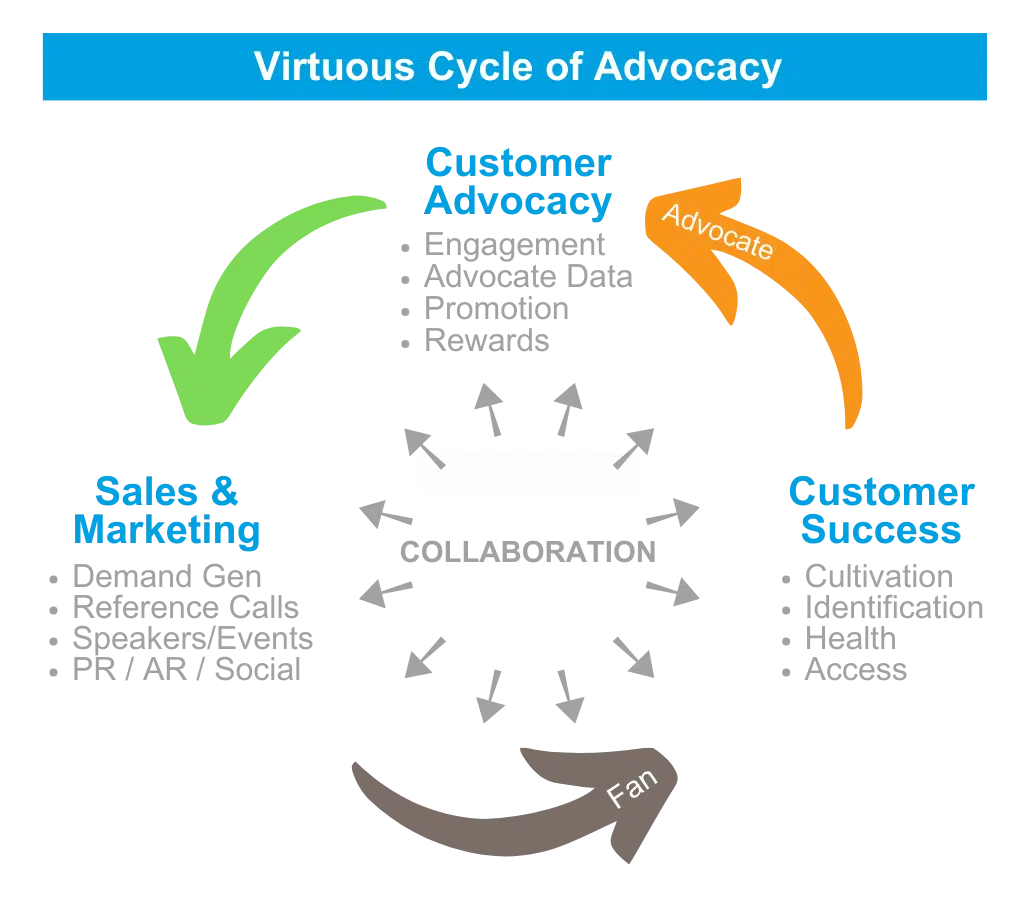
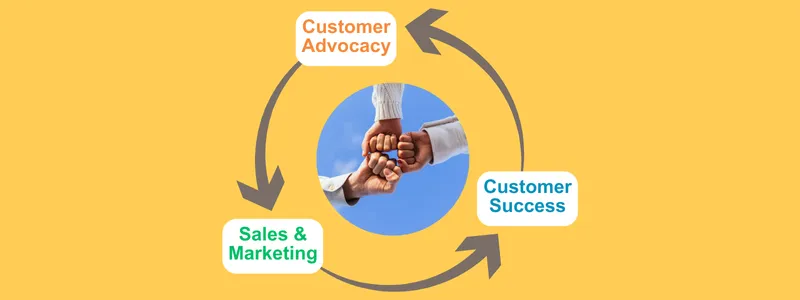
When the customer advocate ecosystem is healthy, we call it the Virtuous Cycle of Advocacy. Customer Success transforms fans from recent closed/won opportunities into advocates. Customer Advocacy keeps those advocates engaged, feeling appreciated and readily available to sales and marketing. Sales & Marketing infuse their activities with advocate stories, and the cycle begins anew.
For so many reasons, customer success should be part of the customer advocacy ecosystem. CS is positioned to cultivate a customer into an advocate through consultative collaboration, the sharing of best practices, problem solving and service excellence. CSMs should have their finger on the pulse of the customer, and various contacts within the account. They should know the org structure, be aware of outstanding support cases, changes in personnel, activities that limit a contact’s availability (e.g., vacations) and the company initiatives to be supported.
A common obstacle to fully integrating CS into the advocacy ecosystem is how success is measured. We often hear that when it’s suggested that CSMs play a role in keeping advocate information up-to-date, nominating advocate candidates and helping fulfill advocate requests, CS leaders and managers say no. The reason is usually, “the CSMs don’t have time.” That position effectively cuts off the oxygen to the advocacy program, which in turn makes leveraging the top customer evangelists for the company’s solution for marketing and sales activities a whole lot harder, and circuitous. What should be a firehose of amplified customer success stories, in a multitude of forms, is instead, a trickle.
Why the pushback from CS leadership? All CS organizations are measured on customer satisfaction and retention rates. But it turns out that a minority of CS organizations have customer advocacy as a performance metric. But isn’t cultivating a customer champion the real end goal? If you want to look at the question in financial terms, a customer’s retention may be worth $100,000 in contract value. But if that same customer is willing to talk to prospects, present at events, and participate in a video interview for a lead gen campaign, they can influence tens of buyer decisions worth millions of dollars! So, should retention alone be the ultimate prize? That’s a hard argument to make.
A post-pandemic trend we’ve observed is the elimination of customer success departments. That’s a decision that’s hard to wrap your head around if you believe a customer-centric function should be immune from the broad cost-cutting chopping blocks. However, not all customer success functions are created (or run) equally. Some have not been able to quantify their value to the organization. If customer sat, retention, and account growth—not to mention the influence of advocates on sales—cannot be attributed to CS, it is no more than overhead to a CFO. And CFOs are measured on and rewarded for their cost containment and reduction initiatives, among other things. Wall Street rewards boards for said cuts.
What’s a customer advocate program to do when relationship management is entirely in the hands of account executives? It depends on the nature of the account management. If, for instance, there is little reason for an AE to keep in touch with a customer months after a deal closes, or the contract is renewed, they won’t be a lot of help. They’re largely in the dark about the account. If the solution demands that the AE stay in regular contact with her customers for upsell and cross sell purposes, then they should have the same level of insights as a good CSM would have. In that case, the AE, who depends on having advocates to help close opportunities, or upsell and cross sell, should be interested in developing advocates from their own customer portfolio. But, they’re not usually incentivized on that objective. Some AEs just intuitively get the symbiotic relationship between sales and customer advocacy programs. But more don’t, and view their participation as optional and ancillary—rather than connected—to reaching quota.
If you have an uncooperative CS team, your first option is to work on leadership, perhaps with the assistance of your department leaders. There’s a very good argument for adding advocacy to existing performance metrics. It’s not just a soft and fuzzy argument, it’s a solid financial argument. The “don’t have time” objection as it pertains to helping with the fulfillment of advocate requests is nonsensical because CSMs are probably already doing it on an ad hoc basis. Salespeople know who have the customer relationships, and they aren’t shy about reaching out to CSMs in Slack or Teams. It’s not a formal process, but it’s happening and it’s a real cost. There’s no use pretending.
If you can’t overcome the blockers in CS leadership, and they turn out to be unpersuadable; or you have an unresponsive AE team, then you have to build relationships with customers directly. This is time-consuming and duplicative of relationship management functions like CS, account management or Sales (acting as de facto CSMs). Organizational design wonks would wince at such an inefficient design, but sometimes you have to work with dysfunction until fortuitous change comes with personnel change.
A good place to start building your advocate database is NPS or customer satisfaction survey results. The most positive respondents become your prospect list. Reaching out to these customers may ruffle feathers, so be sure to work with any of your peers who have relationships with those customers. Explain your plan and why you’ve decided to take this course of action. Get them comfortable with your approach and include them in whatever manner is appropriate. Then, keep them informed of your activities, and be diligent about sharing any insights you glean that may help them with account growth and renewal.
Keep these, now personal, advocate contacts engaged through regular communication which is useful, educational or otherwise valuable. Plan to talk with them on a recurring basis so the times you ask them for something aren’t the only times they hear from you. Done well, you will become a valued company resource for your advocates. We hear stories all the time of program managers helping to get support issues escalated, connecting an advocate with a company resource they didn’t know existed, and getting solution enhancements onto product roadmaps. Most importantly, help your manager understand that this path takes a lot more bandwidth than partnering with your cohorts in a true advocate ecosystem. The “do more with less” mindset kind of falls apart if you’re playing more than your fair share of the ecosystem parts.
Every organization stands to benefit mightily from an efficient, operationalized customer advocacy program. When advocacy practices are inconsistent, reactive and unpredictable the results produce a bad customer experience. This is more likely when company leadership doesn’t recognize that advocacy is a result of CX excellence. Regardless of the environment in your organization, you can still have a personal impact on CX. Without leadership support and participation, it will be a much smaller impact, but impact nonetheless. But if you can win leadership hearts and minds with a vision of a fully enabled advocacy ecosystem, you will drive outsized results in terms of customer acquisition, satisfaction, growth and retention that really matter—to the board!





.svg)
