Becoming a Strategic Customer Advocacy Program Leader
The term strategic is tossed around all the time. We all want to be strategic. Tactical sounds so pedestrian, right? Some in customer marketing might view the customer reference management component as tactical. Respectfully, I vehemently disagree.
How does one become strategic and behave strategically in the context of customer reference management? It begins with how you view your program, which lets co-workers and executives know how they should view your program.
On the surface, what are the primary objectives of customer reference management?
Build and maintain a database of prequalified customer advocates
Make finding and securing customer advocates more efficient
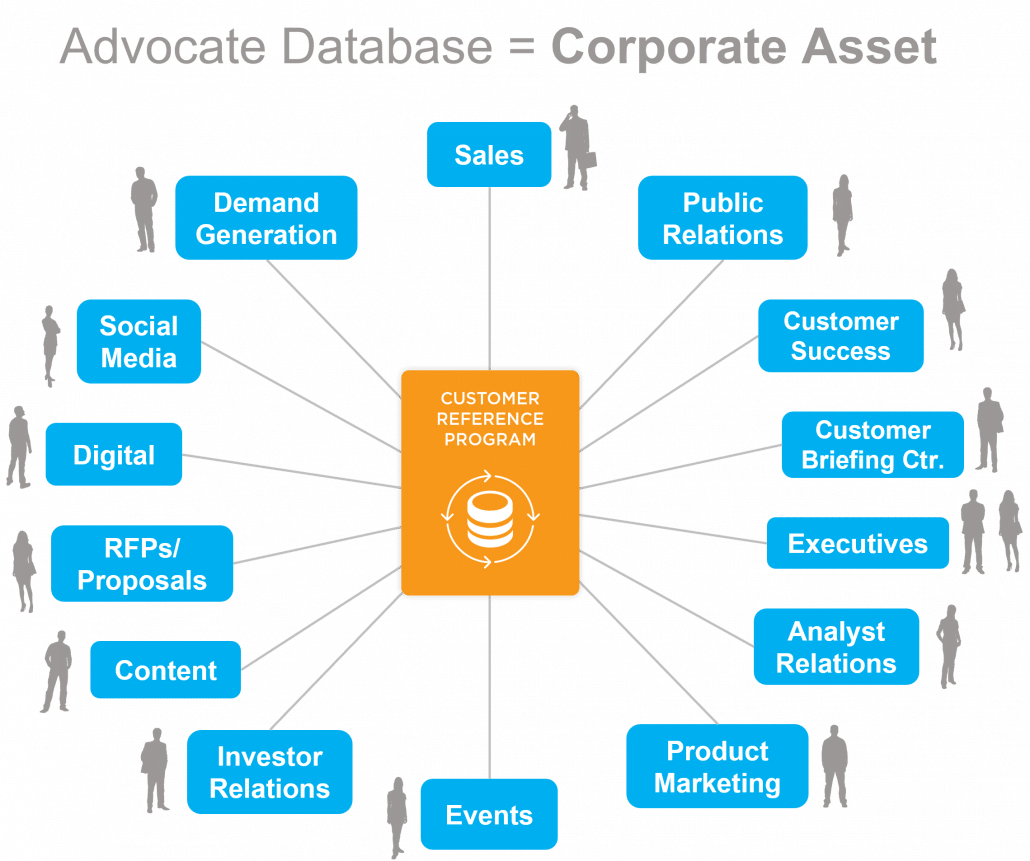
These objectives are not just about supporting Sales. Far from it. The advocate database is a corporate asset that—built, used and maintained properly—improves any activity with the infusion of customer advocate experiences and insights (customer videos and quotes in campaigns, live presentations at conferences, sales calls, earnings calls, investor calls, etc.).
The reality is that most customer marketing managers must be both strategic and tactical simply because there are many teams of one out there. If that’s your situation, then think of the following as “hats” you wear, and not different people.
The strategic person asks what should we be doing and why, which markets and segments will be critical in the future, how will we differentiate ourselves, what trends will impact how we do business, what is happening in the world and how does that apply to our business/my team?
The tactical person asks what resources, plans, decisions, processes and activities need to be in place and/or executed to support the strategy?
Connecting the Dots
To act strategically you have to both understand your company’s growth goals and translate your program’s goals and tactical execution to align with those strategic goals.
The Haves and Have Nots
How do you translate all of this to customer reference programs? Following is a list of key program aspects, and two program versions: one without strategic alignment (and therefore perceived value), the other with strategic alignment.
Program Aspect – Not Strategically Aligned vs. Strategically Aligned
Program Aspect
Not Strategically Aligned
Strategically Aligned
Scope
Your program supports only a fraction of enterprise advocate use cases (e.g., only marketing, only sales, only produces customer content, only procures customer reviews, etc.).
You fully support all enterprise advocate needs, in recognition that many departments benefit from advocate stories as part of initiatives that support growth goals.
Program Goals
Your program lacks business outcome goals (e.g., revenue influenced), or goals are not connected to company growth goals (e.g., add X reference accounts, even if unrelated to demand and company goals).
Advocate recruiting, request fulfillment and ultimately revenue influenced is clearly in support of company growth goals.
KPI data, shared regularly with leadership, reflects your program’s impact on company growth goals.
Relationship with Leadership
Key leadership (VP Sales, CMO, CRO, VP CS) know little to nothing about your program.
You don’t think leadership cares about, or has time for your program, so you hesitate to engage them.
Your program is on leadership’s radar because they see its relevance to what they care about.
There is regular engagement with leadership to share successes, and secure assistance with program obstacles.
Relationships with Sales
You/Your program is not known to most sellers.
Sellers don’t view the program as helpful in meeting quota.
You don’t have a deep understanding of Sales operations (avg. deal size, avg. sales cycle, % of deals requiring references, etc.).
You don’t have a regular “slot” on Sales meetings for program topics.
The program is on leadership’s radar.
Key leadership understands the program’s purpose, and alignment with leadership’s growth goals.
There is regular engagement with leadership to share successes and secure assistance with program obstacles.
Relationships with Marketing
You don’t meet regularly with PR, Events, Social, Demand Gen, etc., to understand initiatives, and propose reference solutions.
Reference needs in 3-6 months aren’t known, which would inform recruiting plans/goals.
Marketing departments are still using “back pocket” references rather than working through your system to track, protect and reward advocates.
You allocate time to join stakeholder department meetings to learn of future plans and provide advocate consulting.
Marketing departments wouldn’t make a move regarding the use of advocates without consulting you.
You have specific Marketing advocate needs included in your proactive recruiting plans/goals.
Relationships with Customer Success
Customer Success views you as extra work.
CSMs view customer reference activities as a distraction.
When asked for advocate nominations, CSM provides little to no candidates.
CS is not measured on customer referenceability.
You work closely with Customer Success managers to align goals.
You have helped CS managers establish performance metrics related to referenceability.
CSMs know and trust you to use their time efficiently, and maintain, if not improve, customer relationships.
Training & Education
Employees are not trained on how advocates are to be incorporated into their activities, in support of company growth goals.
Advocate best practices are not taught at onboarding, or otherwise.
Sales and Marketing receive regular training and reference best practices in team meetings.
As new advocates and customer content is added to support growth goals, Sales and Marketing are notified and coached on optimal use.
Leadership Planning
You are not included in planning that should incorporate advocates such as product launches, new industry-aligned GTM plans, regional event initiative, etc.
You have a seat at any relevant planning meeting because your program is viewed as an integral part of Sales and Marketing initiatives.
The Wrap
At a recent customer marketing conference, attendees were surveyed and asked about their career ambitions. Well over half had C-Suite positions in mind. To get there it’s important to start thinking like an executive in your customer marketing role, and developing that executive muscle now. It’s a form of training: think of it like you’re marathon training only for your career rather than a race. Once your strategic potential is recognized, doors will open and you’ll be on your way. But stay purely in the tactical space and you’ll simply be a best-kept secret.







.svg)
