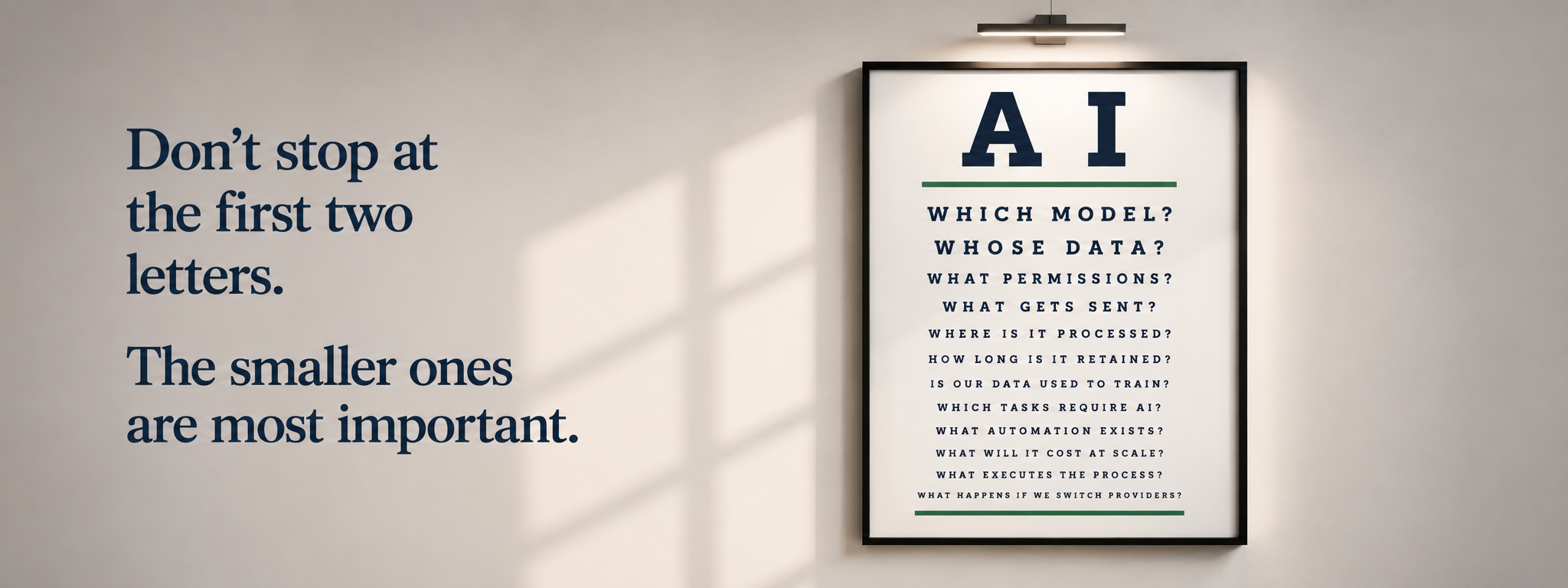
AI has become a standard feature of customer advocacy and customer marketing platforms.
Or at least the letters AI have.
Features are AI-powered. Search is AI-powered. Matching is AI-powered. Workflows are AI-powered. Insights are AI-powered. AI has enormous potential to change how people interact with advocacy programs. But buyers need to understand what they're actually buying.
Because "AI-powered" describes positioning, not an architecture.
The most useful question to ask when evaluating an AI capability is: "How exactly does AI do that?"
You may discover that some capabilities described as AI are actually conventional automation. We don't consider that inherently bad, although potentially dishonest. If a predictable, repetitive process can be executed faster, more reliably, and less expensively with automation, using an LLM simply because AI sounds more exciting may be poor engineering.
AI tokens cost money. As usage expands from a handful of enthusiasts to hundreds or thousands of employees performing everyday tasks, those costs matter. The objective shouldn't be to maximize AI usage.
It should be to use AI appropriately to produce value.
There's a difference between intelligently using automation and calling automation AI. Honesty matters.
Customer advocacy platforms may use proprietary AI, commercial models, or an enterprise AI environment already selected by the customer. Does the advocacy vendor have a proprietary model? Does it use commercial models such as Claude, ChatGPT, Copilot or another provider? Does the customer have a choice? Many enterprises have already spent considerable time deciding which AI environments they will support. Security, legal, IT, procurement, and data-governance teams have evaluated providers, established policies, and determined how employees can use them.
So ask:
Can your technology leverage the AI platform our company has already chosen? And, what if we change it?
That's very different from, "Here's the AI that comes with our software."
AI-powered customer advocacy technology should only access the customer and advocacy data required for the task and that the individual user is authorized to access. Customer advocacy rarely exists in an isolated database.
The best advocate for an activity may depend on CRM information, opportunity data, products purchased, case history, account characteristics, relationship ownership, previous advocacy activity, survey feedback, customer success information, or other enterprise signals.
So ask what information the AI can use. Then ask the more important question:
What information can each individual user access?
If a salesperson, CSM, marketer, and program manager have different permissions, does the AI preserve those differences? AI shouldn't become a convenient side door around enterprise governance.
Buyers should understand exactly what customer data is sent to an AI model, where it's processed, how long it's retained, and whether it's used for model training.
Ask:
Don't accept "enterprise-grade security" as the answer. That's a label. Ask how it works.
The cost of AI-powered advocacy technology depends partly on how frequently workflows invoke an LLM and how many tokens those interactions consume at scale. AI demonstrations generally involve one person asking a handful of questions. That's not the usage model buyers should evaluate.
What happens when 500, 1,000, or 5,000+ employees start using it?
Which activities consume tokens? Which model is being used? Does every step of a workflow require another trip through the LLM? Is AI repeatedly reasoning through processes conventional software could handle deterministically? Small architectural differences multiplied by thousands of searches, nominations, and requests can become meaningful costs.
Ask about expected token consumption at scale.
AI is particularly valuable for interpreting natural language, understanding intent, synthesizing information, finding patterns, and providing a conversational way to interact with customer advocacy systems. But that doesn't mean every step of every advocacy workflow requires AI. Consider a customer advocate request.
Once the system understands that a salesperson wants to request a particular advocate, does an LLM need to reason through every subsequent step? Who owns the relationship? What approvals are required? Which notifications should be sent? When should reminders occur? How is the activity associated with the opportunity?
If mature software already contains those business rules, asking AI to rediscover them on every transaction isn't sophistication. It's expensive redundancy.
AI doesn't eliminate the need for customer advocacy domain expertise; it makes the quality of the underlying data, workflows, and business rules even more important. AI can make a young application look remarkably capable remarkably quickly.
Natural-language interfaces can conceal a lot of what is, and isn't, underneath them. But eventually AI encounters operational reality.
What constitutes a good advocate match? How is overuse prevented? Who approves an activity? When does the relationship owner get involved? What happens when an advocate declines? Which activities require program-manager involvement?
AI can interact with those processes. But someone still had to understand them well enough to design them.
AI should sit on top of domain expertise, not be considered a substitute.
ReferenceEdgeAI makes ReferenceEdge data and workflows available through the enterprise AI environment selected by the customer rather than requiring a proprietary Point of Reference AI model. Point of Reference made a deliberate architectural choice with ReferenceEdgeAI.
ReferenceEdge uses the Salesforce CRM MCP to make its data—that's Salesforce data, including ReferenceEdge advocacy data—and workflows available through the enterprise AI environment the customer has chosen. The customer's AI strategy remains the customer's AI strategy. More importantly, Salesforce remains the authority governing access.
Whatever a user is permitted to access in Salesforce governs what that user can access through the connector.
The AI interface doesn't establish a parallel permission universe.
And some of the highest-volume ReferenceEdgeAI use cases are wonderfully ordinary
AI gives users a dramatically easier way to initiate activities they already perform.
A practical approach is to use AI to understand conversational intent and mature software automation to execute established customer advocacy workflows.
Suppose a salesperson asks:
"Find healthcare customers using Products A and B that can speak about implementation."
AI is excellent at understanding that request conversationally. ReferenceEdge already knows how to search the richly tagged advocate database.
Then:
"Request the first one for my opportunity."
AI understands the instruction. But ReferenceEdge already knows how a request works. It has the workflows, business rules, relationship ownership, permissions, approvals, notifications, tracking, and activity history needed to execute the process.
So why ask an LLM to reinvent it?
AI handles the conversation. ReferenceEdge handles the operation.





.svg)
