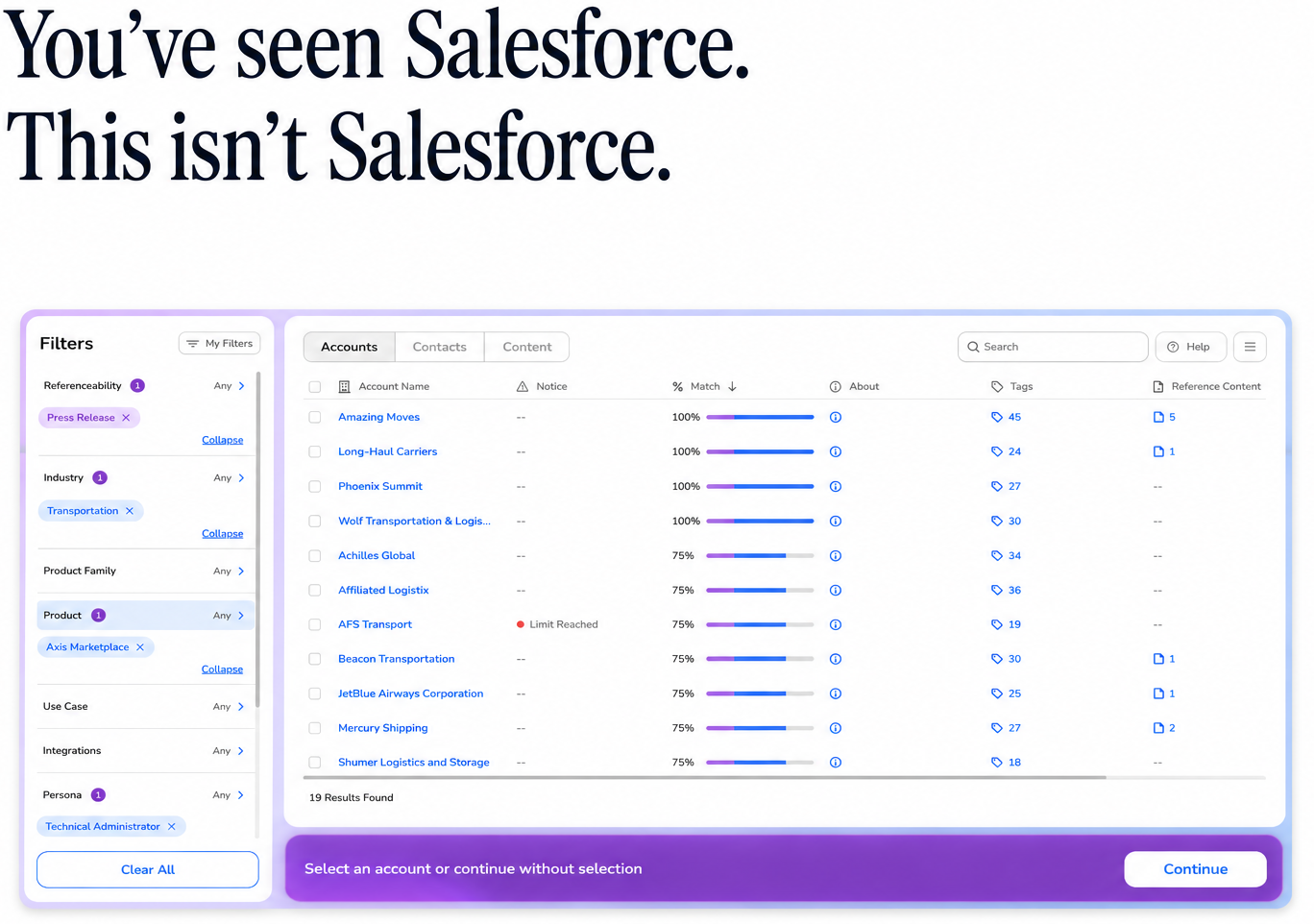
Not anymore.
It's one of the most common misconceptions we hear.
Because ReferenceEdge is built natively on Salesforce, many buyers assume it must look and feel like every other Salesforce application.
That may have been true years ago. It isn't today.
ReferenceEdge was completely redesigned to deliver a modern customer advocacy experience while remaining fully native to Salesforce.
The architecture stayed the same.
The experience evolved.
Absolutely.
Today's ReferenceEdge interface was professionally designed to be more like the applications we use on a daily basis.
The result is software that feels approachable, efficient, and enjoyable to use throughout the day.
The objective wasn't simply to modernize the interface.
It was to create an exceptional user experience.
A modern user interface shouldn't fight the platform it's built on.
ReferenceEdge feels contemporary while remaining harmonious with Salesforce.
It doesn't clash with the Salesforce experience. It complements it.
Users immediately recognize they're working inside the same trusted business platform, while benefiting from an interface purpose-built for customer advocacy rather than generic CRM tasks.
That's an important distinction. A native application doesn't have to look “Salesforce-y.”
Nor should it look like it was bolted onto Salesforce.
ReferenceEdge delivers both.
Behind the modern interface, everything organizations value about Salesforce-native software remains intact.
ReferenceEdge continues to provide:
The interface changed.
The architectural advantages did not.
User adoption is driven by removing friction.
Users can choose the interaction that feels most natural to them, whether that's a professionally designed user interface or a conversational AI experience powered by ReferenceEdgeAI. Behind the scenes, both leverage the same trusted customer data, governance, and proven workflows.
That flexibility matters because customer advocacy spans Sales, Marketing, Customer Success, Product Marketing, Events, and executive leadership. Different users work in different ways.
Giving people a choice removes friction.
Removing friction increases participation.
And greater participation leads to stronger customer advocacy programs.
For years, organizations assumed they had to choose between the advantages of Salesforce-native architecture and a contemporary user experience.
That tradeoff no longer exists.
ReferenceEdge combines the governance, security, reporting, automation, and trusted customer data of a Salesforce-native application with a contemporary user experience built specifically for customer advocacy.
If your impression of Salesforce-native software is based on what it looked like a few years ago, it's time for another look.
The architecture is still Salesforce. The experience is unmistakably ReferenceEdge.